

Selling on Amazon in 2026 is more competitive than it has ever been. Over 70 percent of shoppers browse on mobile. Amazon’s search runs on semantic artificial intelligence. Millions of sellers compete for the same customer attention. In this environment, what separates a product that sells consistently from one that collects dust on a virtual shelf comes down to two things: how well the listing is built, and whether the seller owns the Buy Box.
This article explains how the two are connected, what each one requires, and how to improve both in a systematic way.
Why Listing Quality and the Buy Box Are Inseparable
Many sellers treat listing optimization and Buy Box strategy as separate workstreams. That is a mistake. They feed each other directly.
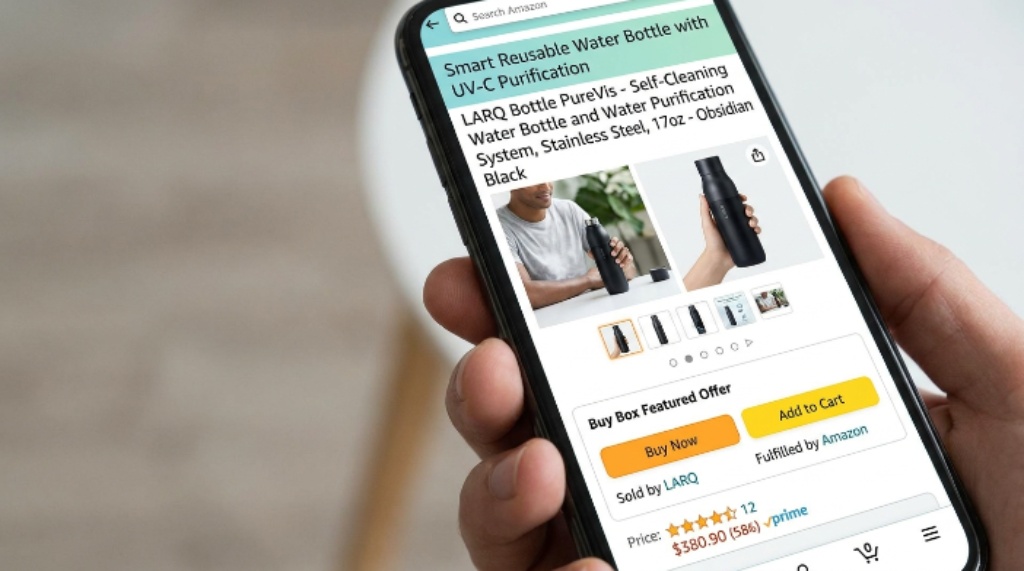
A strong listing drives click-through rate and conversion. A high conversion rate boosts sales velocity. Strong sales velocity improves seller metrics and competitive standing. Better metrics improve Buy Box eligibility. The Buy Box drives over 80 percent of all Amazon purchases. On mobile, only the seller in the Buy Box appears to the buyer at all. Therefore, a well-optimized listing without Buy Box ownership is like a polished shop window on a closed street.
The inverse is also true. Winning the Buy Box without a strong listing means buyers click through and do not convert. Both pieces must work together.
The Core Elements of a High-Performing Amazon Listing
Amazon’s A10 algorithm prioritizes three signals above everything else: relevance to the search query, conversion rate on that query, and external traffic that converts. Keyword density and backend keyword stuffing do not appear on that list. Optimization in 2026 focuses on quality signals, not quantity of keywords.
Product Title
The title is the single most important field on a listing. Amazon weights title keywords most heavily in its relevance scoring. However, mobile screens cut off titles at roughly 60 to 80 characters. The most critical information, including brand name, primary keyword, and key product differentiators such as size, material, or count, must appear in the first 80 characters. Everything else comes second.
Avoid all caps, exclamation points, and promotional language like “best seller.” Amazon de-ranks listings that use marketing copy in titles.
Product Images
The main image is the single biggest driver of click-through rate from search results. No amount of keyword optimization compensates for a weak main image. The main image must show the product clearly on a white background, in compliance with Amazon’s Terms of Service.
Beyond the main image, sellers should use all available image slots. The most effective additional images include lifestyle photos showing the product in use, infographic overlays highlighting key features, scale comparison shots, and close-ups of materials or textures. The conversion lift from better images typically shows up within days of updating them.
Bullet Points and Product Description
Bullet points should lead with a customer benefit, then support it with a feature. A structure of feature followed by benefit, starting each bullet with a clear outcome the buyer cares about, performs better than a list of raw specifications. Each bullet should integrate relevant keywords naturally rather than forcing them into awkward phrasing.
The product description expands on the story the bullets begin. It is indexed by Amazon and read by buyers who want more detail before committing. Clear, readable prose organized around the buyer’s key concerns converts better than keyword-stuffed paragraphs.
A+ Content
A+ Content replaces the standard product description for brand-registered sellers. The modules that perform best include comparison charts showing the product against other SKUs in the brand’s lineup, and lifestyle imagery blocks showing the product in real-world context. A+ Content does not directly change search ranking, but it lifts conversion rate, which creates a compounding effect on organic position over time. Sellers should build A+ Content for their highest-volume SKUs first, then expand across the catalog as resources allow.
Backend Search Terms
Backend search terms are indexed by Amazon but not visible to buyers. They capture synonyms, alternate spellings, and related queries that do not fit naturally into the visible copy. The field allows up to 249 bytes. Duplicating keywords already used in the title wastes space and provides no additional ranking benefit.
Understanding Buy Box Eligibility in 2026
The Buy Box, now also called the Featured Offer, does not go to the lowest-priced seller automatically. Amazon’s algorithm weighs multiple factors simultaneously. The May 2025 algorithm update replaced the old sales-velocity-dominated model with a multi-factor approach in which customer satisfaction, delivery speed, and external traffic now carry more weight than before.
Key Eligibility Requirements
To compete for the Buy Box, sellers need a Professional Seller account and at least 90 days of selling history. Beyond those basics, the following performance thresholds apply.
| Metric | Required Threshold |
| Order Defect Rate (ODR) | Below 1% |
| Pre-Fulfillment Cancellation Rate | Below 2.5% |
| Late Shipment Rate | Below 4% |
| Valid Tracking Rate | Above 95% |
| On-Time Delivery Rate | As close to 100% as possible |
Sellers whose ODR rises above 1 percent risk losing Buy Box eligibility entirely until the metric recovers.
How Fulfillment Method Affects Buy Box Share
Fulfillment by Amazon (FBA) is the single biggest lever available to most sellers. Amazon trusts its own fulfillment network over third-party logistics by default, and FBA sellers typically win the Buy Box three to five times more often than Fulfillment by Merchant (FBM) sellers on identical listings with comparable pricing. The Prime badge that comes with FBA lifts conversion meaningfully on category searches, because Prime members filter heavily for Prime-eligible products.
FBA sellers can often price 10 to 15 percent above FBM competitors and still win the Buy Box, because fulfillment speed and reliability carry heavy weight in the algorithm.
FBM sellers can still compete, but the bar is higher. Exceptional account health metrics, reliable tracking, and fast regional delivery are required to overcome the structural advantage FBA provides. Seller Fulfilled Prime (SFP), which allows FBM sellers to display the Prime badge by meeting Amazon’s delivery standards independently, offers a middle path for sellers with strong logistics operations.
In 2026, Amazon’s algorithm also weights regional delivery speed more heavily than it did in previous years. An FBM seller who can deliver the next day to major US metros including New York, Los Angeles, Chicago, and Dallas may outperform an FBA seller whose inventory sits in a single fulfillment center far from those markets.
Pricing and Inventory
Competitive pricing does not mean the lowest price. It means the best total landed price, which is the item price plus shipping, relative to the value the seller’s fulfillment method and metrics deliver. Amazon also monitors external pricing. If a product sells for significantly less on Walmart, Target, or eBay, Amazon’s Fair Pricing Policy can suppress the Buy Box entirely, even for well-performing sellers.
Inventory management directly affects Buy Box share. The moment stock hits zero, a listing drops from Buy Box rotation. Additionally, Amazon’s algorithm accounts for inventory depth in rotation share. A seller holding 80 percent of available inventory on an ASIN typically earns roughly 80 percent of Buy Box time. Running out of stock frequently signals unreliability to the algorithm, and Buy Box share often stays depressed for days after restocking.
How Listing Optimization and Buy Box Strategy Work Together
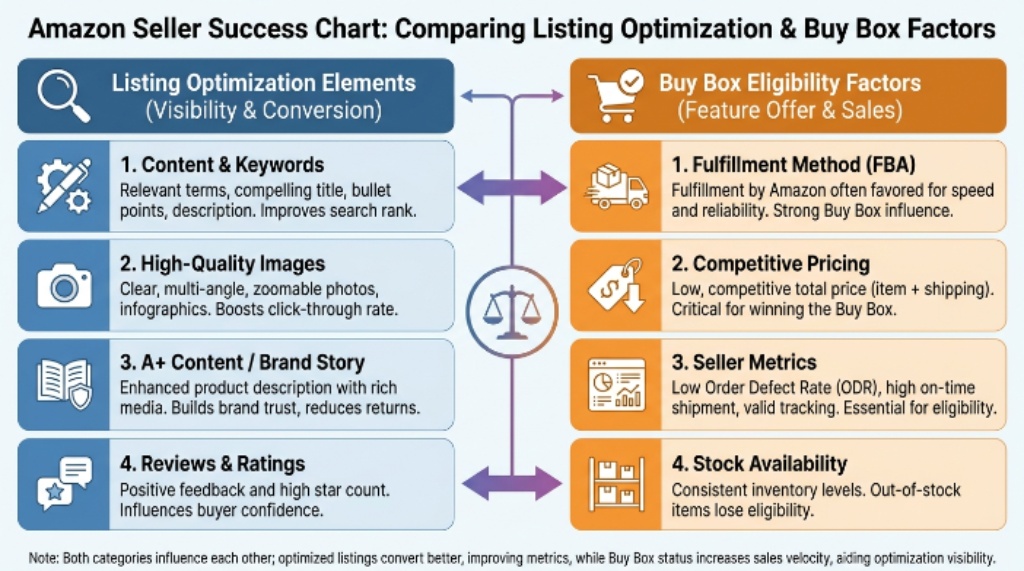
The relationship between listing quality and Buy Box performance creates a compounding cycle. A well-optimized listing increases conversion rate. Higher conversion rate increases sales velocity. Strong sales velocity strengthens seller metrics and competitive signals. Better metrics and signals improve Buy Box eligibility and rotation share. The Buy Box drives more sales. More sales generate more reviews, which further improve conversion rate.
Conversely, sellers who win Buy Box share without investing in listing quality see buyers bounce away without purchasing. Sponsored product ad spend goes to waste. Sales velocity stagnates, and Buy Box share eventually rotates to competitors with stronger conversion signals.
The table below summarizes the key levers across both areas and their relative impact.
| Element | Affects Listing Ranking | Affects Conversion | Affects Buy Box |
| Product title | High | Medium | Low |
| Main product image | Medium | High | Low |
| Bullet points | Medium | High | Low |
| A+ Content | Low | High | Low |
| Review count and rating | Medium | High | Medium |
| FBA fulfillment | Low | Medium | High |
| Order Defect Rate | Low | Low | High |
| Competitive pricing | Low | Medium | High |
| Inventory availability | Low | Low | High |
| Sales velocity | High | Low | Medium |
Practical Steps to Improve Both at Once
Sellers who want to move the needle on both listing performance and Buy Box ownership at the same time should follow a prioritized approach.
Start with the main image. It drives click-through rate more than any other single element, and conversion lifts often appear within days of updating it. Then audit the title for mobile truncation. If the most important product information does not appear within the first 80 characters, rewrite the title before doing anything else.
Next, confirm FBA enrollment or evaluate Seller Fulfilled Prime eligibility. Without Prime-level fulfillment, Buy Box competition becomes structurally harder regardless of how strong the listing is.
Review account health metrics weekly. An ODR creeping toward the 1 percent threshold needs immediate attention. Responding to negative feedback, resolving A-to-z claims, and improving order processes are all faster interventions than they may appear.
Implement a dynamic repricing strategy. Static prices lose to competitors who adjust pricing in real time based on Buy Box conditions and margin guardrails. Most serious sellers use repricing tools that automate this process across large catalogs.
Finally, build A+ Content for the top-performing SKUs and refresh listing images on the next tier. Reviews and ratings improve over time as listing quality and conversion combine to generate more satisfied buyers. The cycle reinforces itself at every step.
Conclusion
Amazon product listing optimization and Buy Box performance are not independent goals. They are two sides of the same competitive equation. A listing optimized for relevance and conversion supports the sales velocity that strengthens seller metrics. Strong seller metrics, combined with FBA fulfillment, competitive pricing, and healthy inventory, support consistent Buy Box ownership. The Buy Box captures over 80 percent of purchases, particularly on mobile. Sellers who invest in both areas simultaneously create a compounding cycle of improved ranking, higher conversion, and growing sales that reinforces itself over time. The starting point is always the main image and the title. From there, fulfillment method, account health, and pricing strategy determine how much of that traffic converts into owned sales rather than lost clicks.
Frequently Asked Questions
What is Amazon product listing optimization and why does it matter?
Amazon product listing optimization is the process of improving a listing’s title, images, bullet points, description, A+ Content, and backend keywords to increase both search visibility and conversion rate. It matters because Amazon’s algorithm ranks products based on relevance and conversion signals, and a well-optimized listing converts more browsers into buyers, which compounds into better organic ranking over time.
How does a listing affect Buy Box eligibility?
A listing does not directly determine Buy Box eligibility, but it affects it indirectly. A strong listing increases conversion rate and sales velocity. Higher velocity improves the seller’s competitive standing and metrics history, both of which influence how Amazon allocates Buy Box rotation share among eligible sellers.
What are the most important factors for winning the Amazon Buy Box in 2026?
The most important factors are fulfillment method, with FBA providing the largest structural advantage; competitive total landed price including shipping; Order Defect Rate below 1 percent; Late Shipment Rate below 4 percent; and consistent inventory availability. Amazon’s 2025 algorithm update also increased the weight given to customer satisfaction signals and regional delivery speed.
Can FBM sellers win the Buy Box against FBA sellers?
Yes, but the path is narrower. FBM sellers need exceptional account health metrics, reliable tracking with a Valid Tracking Rate above 95 percent, and fast regional delivery to compete. Sellers who qualify for Seller Fulfilled Prime, which provides the Prime badge without using FBA, have a stronger shot at consistent Buy Box rotation compared to standard FBM sellers.
How often should sellers update their Amazon listings?
Sellers should review listings regularly rather than treating them as a one-time setup. Main images and titles should be reviewed any time conversion rate drops meaningfully. A+ Content and bullet points benefit from periodic refreshes based on customer review language and evolving search trends. Account health metrics, pricing, and inventory levels need monitoring on a weekly basis to maintain Buy Box eligibility and rotation share.